
Duration
Learning Mode
Eligibility
Learn industry-oriented skills and practical knowledge
Learn from experienced and qualified faculty members
Get excellent career opportunities in top companies
Dedicated support throughout your learning journey
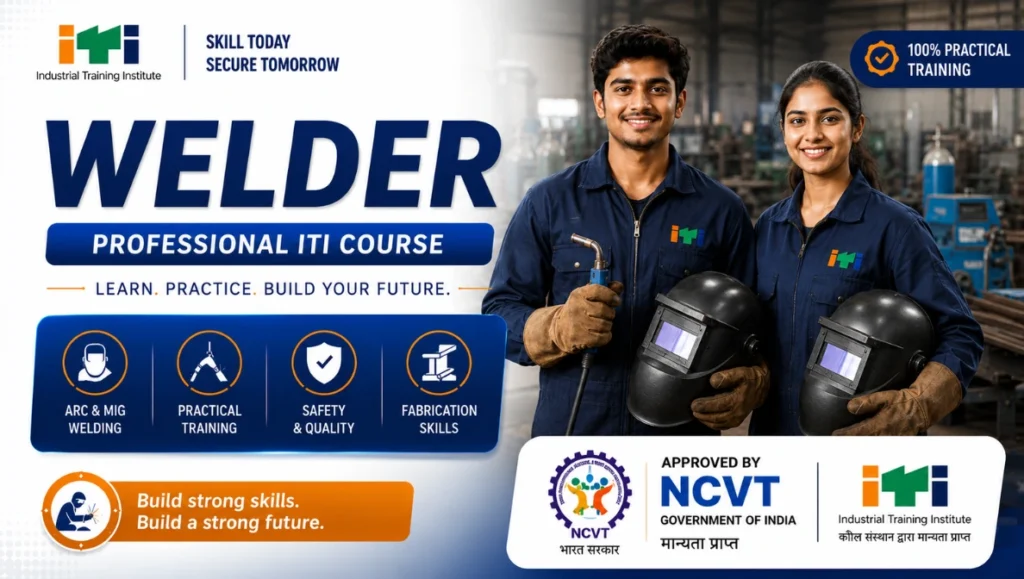
Welder ITI (N.C.V.T)
1 Year
10th Pass
Regular
N.C.V.T
This course is suitable for students who want to develop a practical, job-oriented skill in welding and metal fabrication. It is particularly suitable for those interested in working with welding machines, metal cutting equipment, fabrication work and repair processes. The course is open to candidates who have passed Class 8, with a minimum age of 14 years as on the first day of the academic session. It is a good choice for learners looking to enter manufacturing, engineering, fabrication and related industrial workplaces through practical skill training.
The Welder CTS course is officially structured as a one-year program, rather than a two-semester syllabus in the DGT document.
Semester 1 – Foundation & Basic Welding
Students begin with workshop safety, PPE, hand tools, basic fitting, marking and preparation of metal. They learn Oxy-Acetylene Welding (OAW), Shielded Metal Arc Welding (SMAW), oxy-acetylene cutting, basic weld joints and welding positions. The semester also introduces pipe joints, weld defects, inspection, electrodes, gas equipment and basic engineering drawing.
Semester 2 – Advanced Welding & Specialized Processes
Students progress to pipe welding and welding of different metals such as stainless steel, cast iron, aluminium, brass and copper. They learn GMAW/MIG-MAG, GTAW/TIG, plasma cutting, resistance spot welding, brazing, arc gouging, cast-iron repair, hard facing and plastic welding. The syllabus also covers weld testing, engineering drawing, workshop calculation and science, employability skills and practical project/OJT experience.
Providing Services in Education Field for Past 24 Years
Almost every program offered by us is very affordable
Dedicated support throughout your learning journey