
Duration
Learning Mode
Eligibility
Learn industry-oriented skills and practical knowledge
Learn from experienced and qualified faculty members
Get excellent career opportunities in top companies
Dedicated support throughout your learning journey
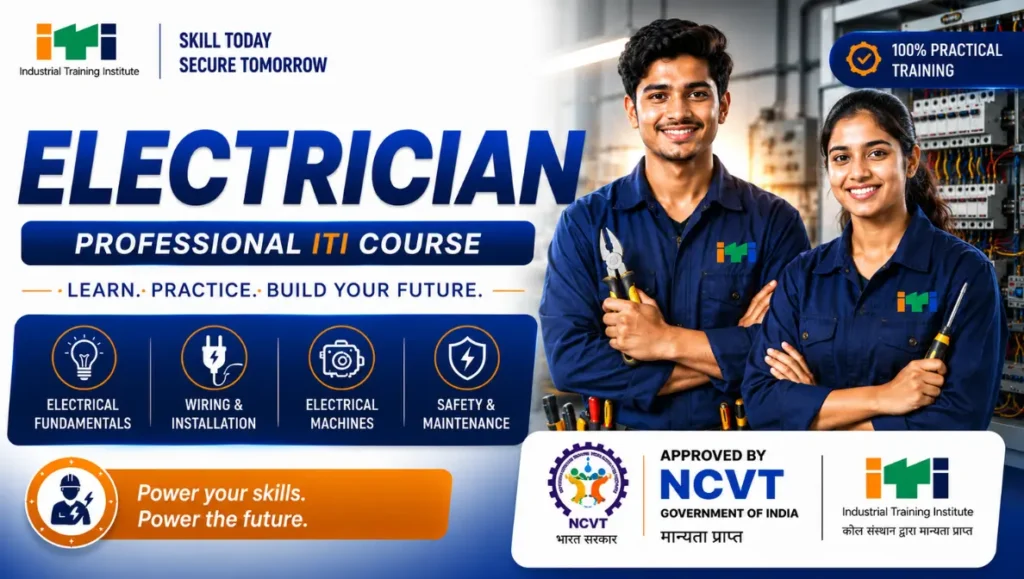
Electrician ITI (N.C.V.T.)
2 Years
10th Pass
Regular
N.C.V.T
This course is suitable for students who want a technical, hands-on career in electrical installation, maintenance, industrial electrical systems, power distribution, electrical machines or renewable energy. It is ideal for learners who enjoy practical work with electrical circuits, tools, machines and equipment and want to work in residential, commercial, industrial or power-sector environments.
The official entry requirement is Class 10 with Science and Mathematics, or a vocational subject in the same sector, or equivalent. The minimum age is 14 years.
The official curriculum is divided into First Year and Second Year.
Semester 1 – Electrical Fundamentals & Wiring
Students begin with electrical safety, PPE, firefighting, first aid and tools, followed by electrical wire joints, soldering, crimping and underground cable testing. They learn Ohm’s Law, Kirchhoff’s Laws, series and parallel circuits, AC/DC basics, magnetism and electrical measurements. The semester also introduces batteries, solar cells and basic electrical wiring.
Semester 2 – Installation, Earthing, Appliances & Transformers
Students develop practical skills in domestic and industrial wiring, MCB/ELCB/RCCB/MCCB, energy meters, earthing, lighting systems and smart meters. They also learn testing and calibration of measuring instruments, repair of electrical appliances such as irons, geysers, induction heaters, mixers and washing machines, and the testing, maintenance and winding of transformers.
Semester 3 – Motors, Generators & Electronics
The second year begins with DC machines, DC motor starters and motor winding, followed by three-phase and single-phase AC motors, starters, speed control and troubleshooting. Students also learn about alternators, MG sets, synchronous motors and electronic circuits, including diodes, rectifiers, transistors, power electronics and basic digital electronics.
Semester 4 – Control Systems, Renewable Energy & EV
Students progress to control cabinet wiring, motor control circuits, AC/DC drives, UPS, inverters, battery chargers and emergency lighting. Advanced topics include solar panels, wind and solar power systems, overhead domestic service lines, power distribution, smart grids, relays, circuit breakers and EV charging stations. Engineering drawing, workshop calculation & science, employability skills and project/industrial exposure are integrated throughout the program.
Providing Services in Education Field for Past 24 Years
Almost every program offered by us is very affordable
Dedicated support throughout your learning journey